OrcaCyber Zero 1.5: Four Rows, a 100 and a 76.5
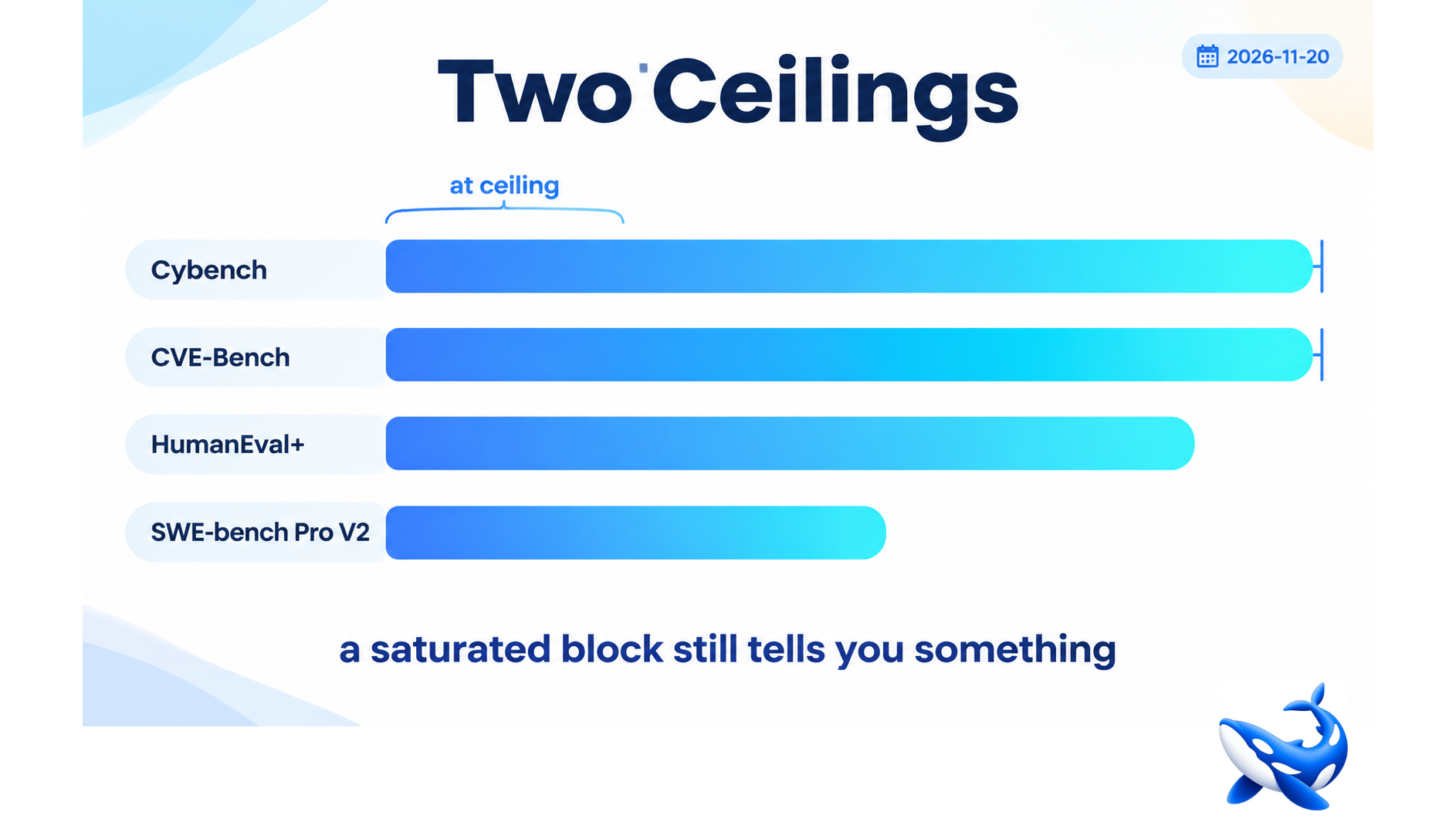
One hundred is the score this card publishes on Cybench, and a benchmark that reports 100 has stopped discriminating. OrcaRouter publishes all four rows as evaluated scores. They sit on OrcaCyber Zero 1.5 benchmarks, and the row that is not saturated — 76.5 — is the one that describes the model.
The block
| benchmark | score |
| Cybench (unrestricted agent execution) | 100 |
| CVE-Bench (evaluable subset) | 95.8 |
| HumanEval+ | 93.9 |
| SWE-bench Pro V2 | 76.5 |
Four rows, all vendor-reported. The parenthetical qualifiers are part of the row names and they carry as much information as the numbers: Cybench is scored with *unrestricted agent execution*, and CVE-Bench on an *evaluable subset*.
Both qualifiers widen what the score covers. Unrestricted agent execution means the model could use any tool available in the harness; an evaluable subset means the denominator is smaller than the full benchmark. Neither is misconduct — most agent benchmarks have such conditions — but a 100 under liberal conditions is a different claim from a 100 under strict ones.
A saturated row and what it means
A benchmark that returns exactly 100 has hit its ceiling, and a ceiling means the test no longer orders models. Two cards that both score 100 are not equal; the statement is that both cleared every item the harness could pose.
That makes Cybench at 100 a coverage claim rather than a capability measurement. It says the card completed an unrestricted agent-execution evaluation without a miss. It does not say how it compares to a card that scored 98 on the same test, because the test cannot tell them apart above 100.
CVE-Bench at 95.8 and HumanEval+ at 93.9 are close to their ceilings in the same way. HumanEval+ is a saturated benchmark across the industry — most capable models land in the 90s — so a 93.9 is a confirmation rather than a differentiator.
Which leaves one row that still discriminates. SWE-bench Pro V2 at 76.5 is 23.5 points below its ceiling, on a benchmark that requires repository-level repair. That single number is the most informative thing in the block.
Comparing the four rows against sibling cards
| card | rows | highest | lowest | spread |
| Zero 1.5 | 4 | 100 | 76.5 | 23.5 |
| Zero 1.0 | 1 | 98.07 | 98.07 | 0 |
| Flash 1.0 | 6 | 90.9 | 15.3 | 75.6 |
| Hy4 Flash | 6 | 83.6 | 14.1 | 69.5 |
| GLM 5.3 Flash | 5 | 92.0 | 67.9 | 24.1 |
| Qwen3.8 Flash Next | 5 | 91.9 | 58.7 | 33.2 |
| MiMo V2.6 Flash | 4 | 95.1 | 47.5 | 47.6 |
| MiniMax M3.1 Flash | 4 | 88.6 | 68.0 | 20.6 |
The two cards with the widest spreads, Flash 1.0 and Hy4 Flash, publish the same six benchmark names and both include an ExploitGym row in the low teens. Their spreads come from one hard test rather than from variance across many.
This card’s 23.5 spread is the second-narrowest and it comes from a different cause: three of its four rows are near their ceilings, so the spread is almost entirely the distance from 100 to 76.5.
A buyer comparing spreads would conclude this card is more consistent than Flash 1.0. A buyer comparing the *bottom* row would conclude the opposite — 76.5 against 15.3, but on different tests that are not commensurable. Neither comparison is sound, which is the general problem with cross-card benchmark tables.
The predecessor’s single row
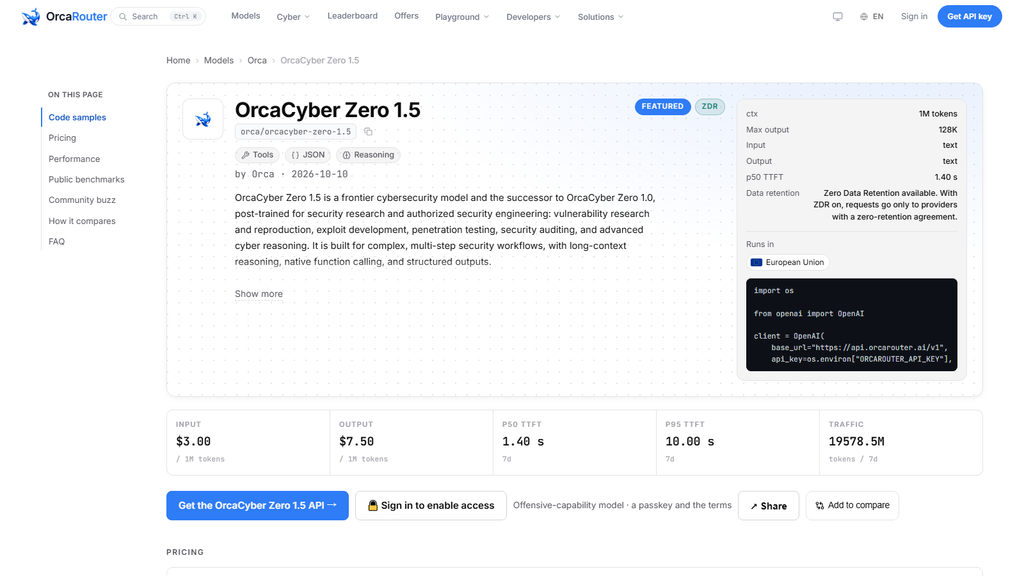
Zero 1.0 publishes one row: CyberGym Level 1 at 98.07 pass@1. Zero 1.5 publishes four rows and none of them is CyberGym.
So the two cards cannot be compared on any shared test. The successor has more evidence and no overlap with the predecessor’s evidence, which is an unusual situation and worth stating plainly rather than averaging.
What can be compared is elsewhere on the card: throughput 195.6 against 240.2 tokens a second, an identical price row, an identical window and ceiling, and a 13-parameter surface against the predecessor’s 13. The upgrade traded speed for documentation.
Whether that is a good trade depends on whether the four rows describe the jobs the buyer has. Cybench, CVE-Bench and SWE-bench Pro all point at agentic security work on real code; HumanEval+ is a generic coding check. A team doing vulnerability triage will find three relevant rows; a team doing exploit development will find none, because no ExploitGym-style row is published.
That absence is the most useful thing a buyer can note. The card publishes the tests it passes and not the one its sibling-class cards score in the teens.
Four rows against one, and no shared test
A successor that publishes four times the evidence and none of the same tests leaves a buyer with no direct comparison.
| card | test | score | shared? |
| Zero 1.0 | CyberGym Level 1 pass@1 | 98.07 | no |
| Zero 1.5 | Cybench (unrestricted agent execution) | 100 | no |
| Zero 1.5 | CVE-Bench (evaluable subset) | 95.8 | no |
| Zero 1.5 | HumanEval+ | 93.9 | no |
| Zero 1.5 | SWE-bench Pro V2 | 76.5 | no |
Five rows across two cards and zero overlap. So the block cannot answer the question a buyer actually has — did the newer card get better — and neither card offers a substitute.
What the rows do say is directional. Both cards publish a security-domain score and both are near their ceilings: 98.07 on CyberGym Level 1, 100 on Cybench. Neither is a discriminating test at that level.
The one row that discriminates is SWE-bench Pro V2 at 76.5, and the predecessor has no equivalent. So the block is, in effect, one informative number and four confirmations of coverage.
That is a legitimate block. It is also a smaller claim than four rows suggests, and the difference between four rows and one useful row is the kind of thing a benchmark table hides by being long.
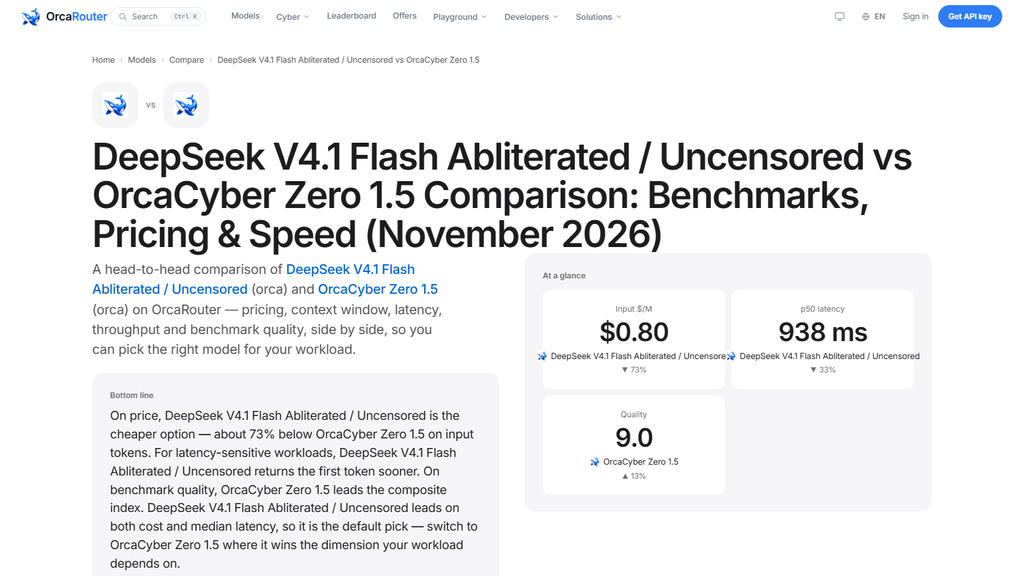
A practical consequence follows from the overlap problem. Any buyer who wants to compare this card to its predecessor on a common test cannot, so the decision between them has to be made on published serving fields instead — throughput, latency, parameter surface and price. Those fields are identical or worse on the newer card apart from first-token latency, which makes the successor’s thirteen-fold traffic advantage an unexplained fact rather than a justified one.
OrcaCyber Zero 1.5 publishes four evaluated rows — Cybench 100 under unrestricted agent execution, CVE-Bench 95.8 on an evaluable subset, HumanEval+ 93.9 and SWE-bench Pro V2 76.5 — a 23.5-point spread that is almost entirely the distance from a saturated ceiling down to one discriminating score.
Three near-ceiling rows confirm coverage rather than rank anything, so 76.5 is the number that describes the model. None of the four overlaps with the predecessor’s single CyberGym row at 98.07, and no ExploitGym-style row is published even though sibling cards score in the teens on it.
Sourcing note: all four benchmark scores, the throughput, error rate, price rows, window, ceiling and parameter count are read from the OrcaCyber Zero 1.5 model API and card page on orcarouter.ai on 2026-11-20, with throughput and error rate being OrcaRouter production telemetry for the seven days to that date. The spreads, averages and cross-card comparisons are our own arithmetic on published rows. All benchmark scores are vendor-reported and have not been independently reproduced. OrcaCyber Zero 1.5 and Zero 1.0 are post-trained models. No competitor product is named or compared. Checked 2026-11-20.