
How to Choose an Albino & Preto Gi for Training or Competition
You can learn a lot about an Albino & Preto gi by looking at the pants first. A clean white jacket might catch your eye, but the waistband is what you’ll adjust between rounds. The knee panels are what you’ll notice when you spend a class working from guard. And if you train after work on two nights in a row, the thickness of the collar may decide whether that gi is dry by the next class.
Albino & Preto, also known as A&P, makes Brazilian jiu-jitsu gis that range from simple Classics to numbered releases with distinctive artwork. There’s room for both in a training bag if you know what you want from each. Start with where you’ll wear the gi most often, how much room you need to move, and which details you’d pay extra to have. Then look at the exact release, since even two similar-looking A&P gis can come with different pants.
Start with the class you attend most
If you’re buying your first gi, ask what your academy allows. Some gyms require a particular color or ask students to use the academy’s uniform. Others give you more choice but have rules about patches. Find out what applies to regular classes and whether open mats have different requirements. A color you can use across your normal week will give you more chances to wear the gi.
Think through your laundry schedule as well. If you roll on Monday and Tuesday, a single uniform needs to dry overnight if you want to wear it both days. The thickest areas, such as the collar and waistband, can hold moisture after the rest of the fabric feels dry. If that’s a problem in your home, factor the cost of a second gi into your budget. Two sets that fit and get used regularly can make your week easier to plan.
Use the gi you already wear as a guide. Maybe you like the jacket but have to pull up the pants between rounds. Maybe the waist fits well and the legs feel short every time you bend your knees. Write down the one thing you want the new set to do better. That gives you a concrete way to judge a product description instead of guessing from the color, fabric weight, or name alone.
Compare the cut and the cloth together
The POC HB Classic in black and the GRB HB Classic in white offer a useful comparison. A&P lists each with a 400 GSM pearl weave jacket in its MN001 pattern and 10-ounce herringbone cotton pants. Both listings describe the Novo 1 pants with a half-elastic waistband and a flat drawcord. If you like that build, compare the colors your gym allows and check which size is available before you pay more for another release with a similar construction.
The black VGB Comp gives you a different jacket weight to consider. A&P lists it with a 380 GSM pearl weave jacket, also using the MN001 pattern. GSM means grams per square meter, so those numbers tell you how much the jacket fabric weighs over the same area. They don’t give you the weight of the complete gi. Size, collar, trim, and pants all add to that figure. Ask for the set weight in your size if you have a tight luggage limit or are weighing in for an event.
The B105 Collage shows what changes when the design takes more of the spotlight. It uses a white base with multicolor accents, a 450 GSM pearl weave jacket, and 10-ounce cotton pants. If the artwork is the reason you want it, pay attention to how it fits with the places you train. If you’re choosing mainly for weekly wear, ask how the jacket moves at the shoulders and whether the pants give you the room you need. A heavier cloth can suit a relaxed cut just as a lighter one can feel tight in a narrow jacket.
Pay attention to how the pants stay up
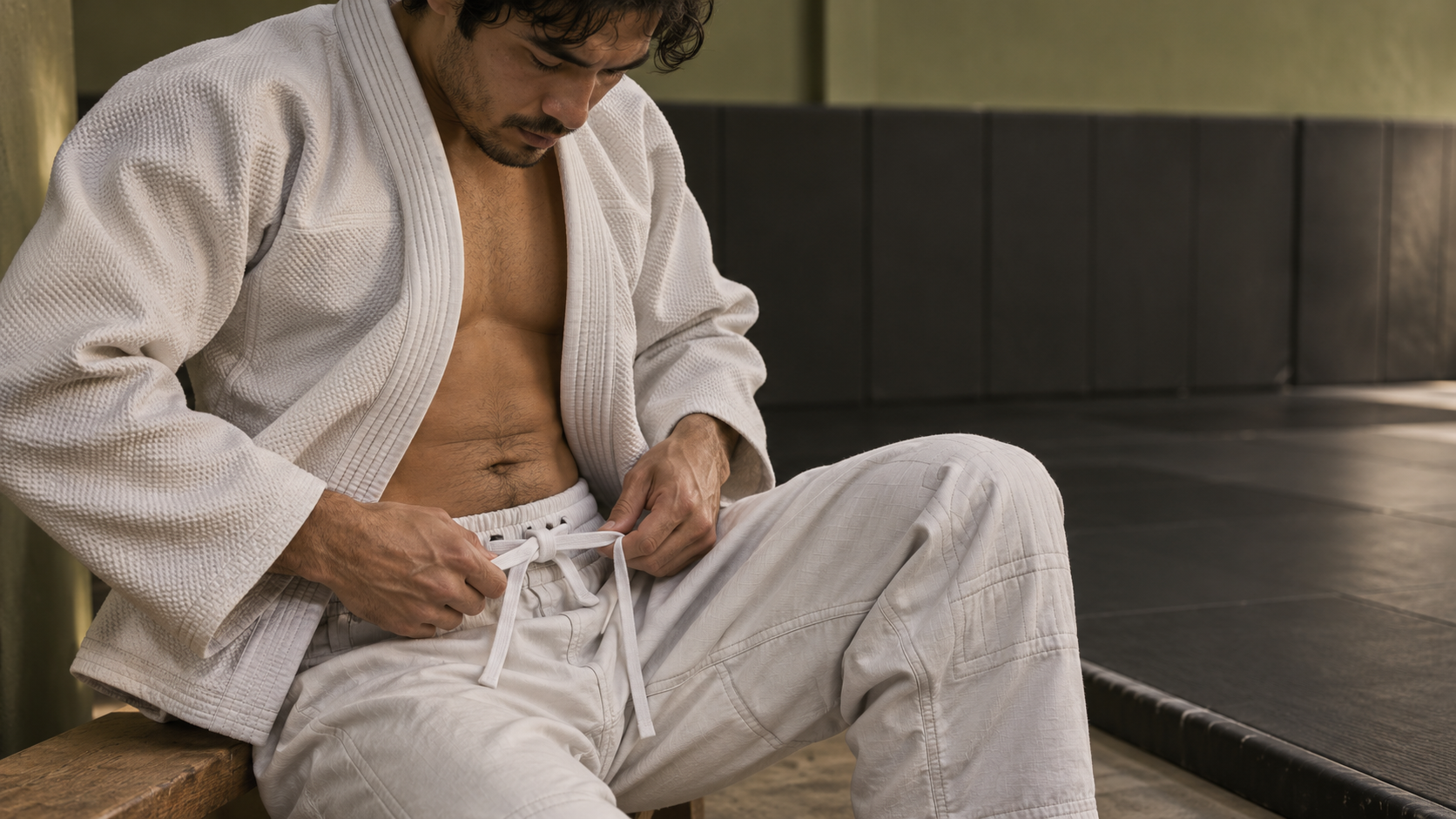
A&P publishes the waistband style on some listings, and it’s worth checking. On the Novo 1 pants described in the Classic models above, part of the waistband stretches and the drawcord lets you adjust the fit. If a teammate has the same pants, ask how the waistband feels through a round. A try-on is even better. Tie the drawcord the way you normally do and check whether you still feel pressure from the waistband when you sit with your knees up.
Herringbone has a diagonal pattern that changes direction to form a zigzag. You can see it up close on the cloth. The fabric name tells you something about the construction, while the fit tells you how much freedom you’ll have to move. Check the depth of the seat, the width across the thigh, and where the knee reinforcement lands. Those details can matter if you often sit back on your heels or take a long step during drills.
When you try on a pair, do a deep squat and stand up again. Check whether the waist has moved and whether the hems settle back at the same point. Then sit with one knee drawn toward your chest. If the pants pull across the thigh or the seat in both positions, ask about a roomier cut. If only the waist feels loose, try a different drawcord adjustment before deciding you need a smaller size.
Use the size chart, then check the measurements
A&P lists lettered sizes and variants such as ML, MT, and LL on some releases. Read the chart for the exact gi. Start with your height and weight, then compare measurements from a set you own. If you’re between sizes, look first at the dimensions that usually give you trouble. For someone with long arms, that might be cuff-to-cuff length. For someone with broad shoulders, it might be chest width and how freely the jacket moves across the back.
Lay your gi flat with the cloth relaxed. Measure straight across the chest just below the armholes and from one cuff to the other with the sleeves extended. Note the jacket length from the collar seam down the back. For the pants, record the flat waist, inseam, and width across one thigh. If the waist stretches, ask whether the seller took the measurement at rest. A photo of the tape can help you compare two listings that use different methods.
Confirm the return terms before taking tags off or washing a new gi. Try on both pieces with a belt. Raise your arms and reach across your body to see whether the jacket pulls. Check how far the skirt hangs below the belt, then make sure you can sit back on your heels in the pants. If the cuffs already feel short, factor in the possibility of further shrinkage before you commit to the size.
Choose a competition gi by the event rules
Use the event’s uniform rules to narrow the field. The International Brazilian Jiu-Jitsu Federation has requirements for color, patch placement, construction, and fit. A&P describes some of its releases as suitable for IBJJF competition, but you’ll still need the specific set you bring to pass inspection. Check the uniform after washing and pay attention to sleeve and pant length. A small change you barely notice in class can matter at a gear check.
If the organizer requires athletes to weigh in wearing the gi, use a scale with the full required kit on. Include the belt if the event requires it. The difference between two jacket fabric weights won’t tell you how much room you have in your weight class. Give yourself enough time to check the actual set rather than leaving that decision to the day of the event. Pack an eligible spare if you already have one and your event setup allows for it.
A competition gi can still be a regular training gi if the cut works for you. Wear it to class before event day so you know whether the pants need adjusting or the collar feels different once the jacket has been washed. That also gives you time to replace a drawcord or deal with a loose seam before you pack.
Decide what an older release is worth to you
A secondhand Albino & Preto gi can make sense when you want a release that’s hard to find or you already know the cut you like. Ask for clear photos of the jacket and pants laid out together, plus close-ups of the labels, collar edge, cuffs, knees, and seams. Compare the set with photos of the original release. Ask whether both pieces came together and whether an owner added patches or altered either piece.
Look at the listing price in light of how you’ll use the gi. If you’re buying for a collection, condition and a matching set may matter more than they do on a uniform you plan to wear twice a week. If you’re buying to train, current measurements and wear at the seams deserve more attention. Ask how the gi has been washed and dried, check the seller’s return terms, and compare the full price with another set you’d use just as often.
Make the final choice with your training bag in mind
When you compare Albino & Preto gis at Strikers BJJ, keep your gym’s rules and your best-fitting measurements handy. A Classic makes sense when you want a set you can wear often. A competition model is worth a look when you know the event rules and can check the fit of the full uniform. A release like the Collage earns its place when you enjoy the design and know where you’ll wear it.
Picture getting ready for a normal class. You should be able to tie the pants once, reach without fighting the jacket, and go home knowing how you’ll wash and dry the set before you need it again. If you’ve found an A&P gi that does those things and you like the way it looks, you have a good reason to buy it.